Firearm ejector pins are small metal retaining components that secure an ejector or retain parts of an ejector assembly, depending on the firearm’s design. Their role is distinct from that of the ejector itself: the pin holds a component in its intended position rather than directly pushing a spent cartridge case out of the action. Extraction and ejection are also separate functions. The extractor generally draws the case from the chamber, while the ejector helps direct it out of the firearm. A correctly specified retaining pin supports that relationship by keeping the associated assembly secure within its intended tolerances. Although these parts can look nearly identical at a glance, they are not universal hardware. Differences in length, diameter, construction, and application can determine whether a pin belongs in a particular assembly. Depending on the design, ejector retention may involve a solid pin, a slotted spring pin, or a coiled spring pin. Each construction has its own mechanical characteristics, and one style should not be treated as a substitute for another simply because their outside dimensions appear similar. Some pins retain an ejector attached to a frame or receiver; others retain a spring-loaded ejector within a bolt assembly. That variation makes the firearm’s parts diagram and the component’s stated application more useful than appearance alone. For owners maintaining a familiar range firearm, professionals servicing customer equipment, or collectors preserving the correct configuration of a firearm, the relevant distinction is exact compatibility. A small retaining component deserves the same attention to specification as a larger, more visible part. Ejector pins belong to a category where clear identification matters more than cosmetic appeal, and where the correct replacement is defined by the original assembly’s requirements rather than by a general claim of strength or versatility.
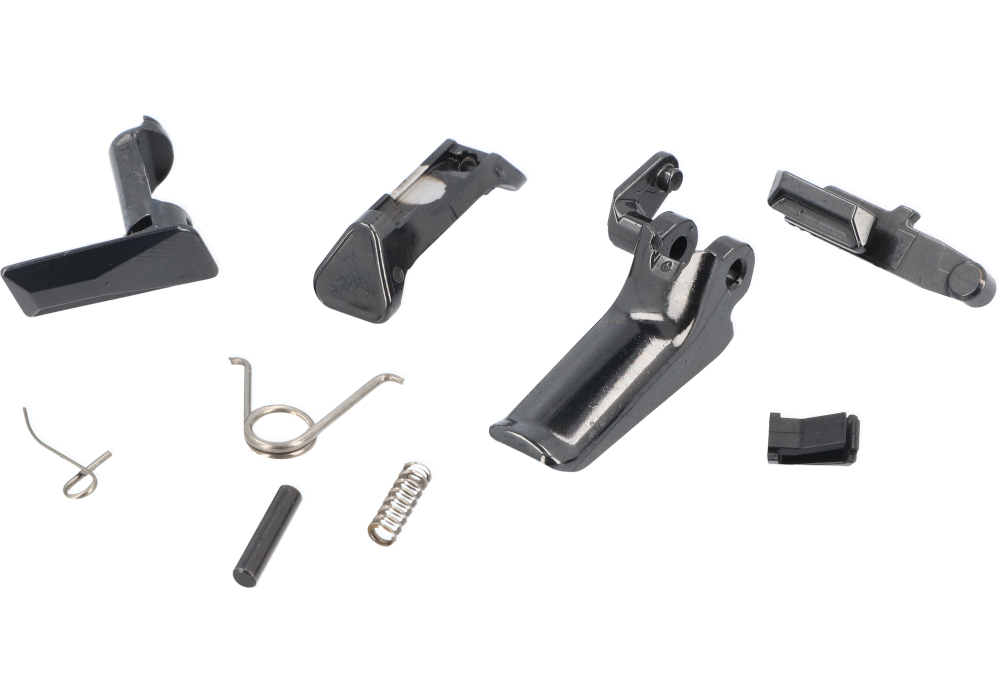
Material and construction help explain how ejector retaining pins perform their supporting role. Steel is common because these components need an appropriate balance of strength, toughness, and resistance to wear. Depending on the application, specifications may call for hardened steel, spring steel, stainless steel, or a particular protective finish. Those descriptions are useful only in the context of the intended design. Stainless steel can offer corrosion resistance, but it is not automatically the right replacement for a pin specified in another alloy; similarly, greater hardness is not a universal measure of better performance. A solid retaining pin and a spring pin can respond differently to loading and contact with their surrounding parts. Slotted and coiled constructions provide controlled resilience where the assembly calls for it, while a solid construction serves a different retention requirement. Surface finish also matters, especially on a component whose dimensions are small enough that seemingly minor differences can affect fit. The most practical selection considerations are the exact firearm model, applicable variant, assembly location, and manufacturer-specified part reference. Where a design has changed over its production history, a familiar model name alone may not establish compatibility. A listing that identifies the relevant assembly and application provides a stronger basis for selection than a photograph without dimensional or fit information. For example, two dark-finished pins pictured against a plain background may appear interchangeable even though they serve different retention points. Matching the documented application avoids relying on that visual resemblance. Durability likewise depends on more than the pin in isolation: the condition of the surrounding assembly and conformity to the specified design both matter. An ejector pin is a replacement component, not a general remedy for every ejection problem or an automatic performance upgrade. Its value lies in meeting the mechanical requirements of the firearm for which it is specified, without introducing uncertainty through an unsupported substitution.
Care for ejector pins is best understood as part of responsible firearm maintenance rather than as a separate cleaning project. Because these components may sit within an assembly, their condition is not always apparent during an ordinary exterior inspection. Corrosion, visible deformation, or a change in how a component sits can warrant evaluation by a qualified gunsmith, particularly when accompanied by irregular firearm function. An ejection issue can have several causes, so a retaining pin should not be assumed to be responsible without an appropriate assessment. Manufacturer-approved maintenance practices and cleaning products help protect both the pin and the surrounding surfaces; unnecessary disassembly can create additional opportunities for damage or lost components. Any inspection should follow the firearm manufacturer’s safety directions, with the firearm unloaded and ammunition kept separate from the work area. Replacement work, especially where retained springs or closely fitted assemblies are involved, belongs with someone qualified to service that design. For shoppers comparing components for a documented repair, Firearm Repair Ejector Pins offers a related category to consider alongside the firearm’s technical documentation. Clear records are particularly helpful when maintaining more than one firearm: keeping a replacement pin in its labeled packaging preserves the connection between a nearly featureless piece of metal and its intended application. A loose pin in a compartment of mixed hardware can be difficult to identify reliably later, even when its purpose seemed obvious at the time of purchase. Clean, dry storage and intact labeling support both condition and traceability without requiring elaborate organization. These parts are generally practical purchases for firearm owners and service professionals with a confirmed maintenance need, rather than casual gifts selected by appearance. If purchased for another owner, the exact required part should already be established. Whether the goal is preserving a well-used training firearm or completing a professional service request, careful selection centers on documented fit, suitable material, and the correct retention design. Those details give this small component its purpose and distinguish a properly specified firearm part from an ordinary pin of similar size.