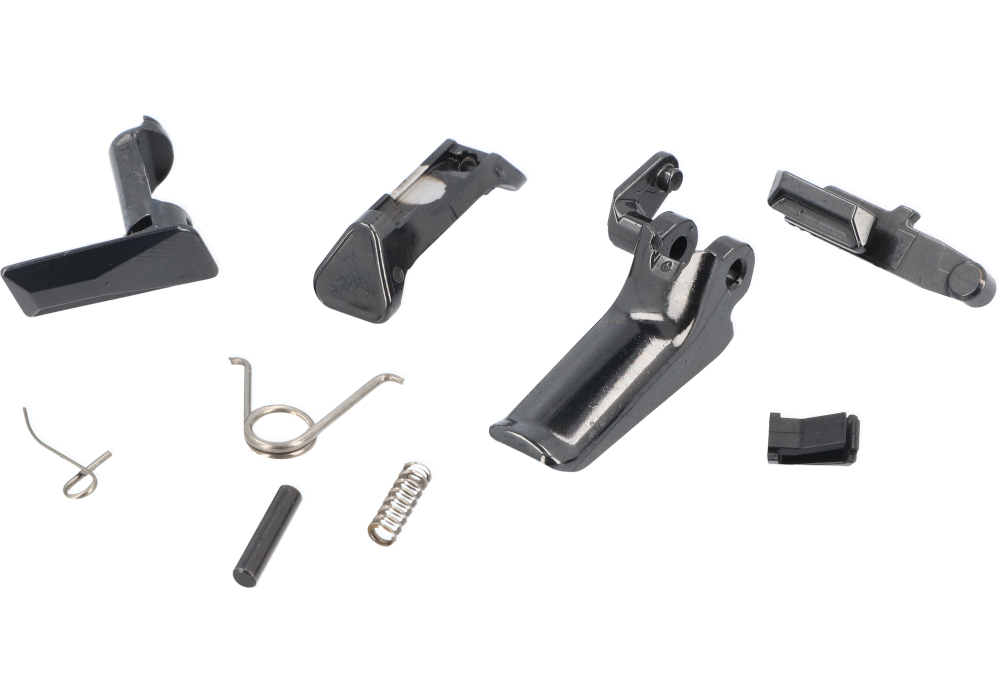
Replacement trigger kits are aftermarket or factory replacement assemblies designed to refine the way a firearm’s trigger feels and performs. Depending on the platform and configuration, a kit may address pull weight, trigger reach, overtravel, take-up, reset, or the overall smoothness of the press. Some shooters prefer a flat trigger shoe that offers a consistent contact point across the finger, while others favor a curved shoe that follows a more traditional profile. Pistol kits may be built around a complete trigger assembly or a replacement shoe and associated components, while rifle kits may use a cassette-style design or individual components that work with the existing fire-control system. In each case, compatibility is the first consideration. Confirm the exact make, model, generation, caliber, frame or receiver configuration, and any factory modifications before ordering, since visually similar firearms may use different trigger parts. It is also important to distinguish between a true replacement trigger kit and a small replacement component intended for a particular assembly. Product descriptions should clearly identify whether the kit is intended for duty, defensive, competition, recreational, or general range use, as the preferred balance of pull weight and reset can vary considerably. A lighter pull is not automatically a better pull; dependable engagement, a defined break, appropriate safety function, and a positive reset are equally important. Shooters who spend long sessions training often notice the difference in the small details—a trigger that feels predictable from the first press, a clean break without excessive creep, and a reset that can be felt without disturbing the sights. Those refinements can make practice more consistent while helping the shooter concentrate on grip, sight alignment, and controlled follow-up shots.
A replacement trigger kit may be considered by a recreational shooter refining a familiar firearm, a competitive shooter seeking a more deliberate and repeatable trigger press, or an experienced owner replacing worn, damaged, or heavily used components. It can also be a thoughtful gift for a qualified adult who already owns a compatible firearm and has a clear preference for trigger shape or feel, although the recipient’s exact model and configuration should be confirmed before purchase. When comparing options, look beyond the advertised pull weight. Consider whether the trigger has an adjustable or fixed design, how much take-up and overtravel remain after installation, the length and feel of the reset, the material and finish of the trigger shoe, and whether the kit includes all required springs, pins, housings, or installation hardware. Some designs are intended as drop-in replacements, while others require careful fitting, specialized tools, or familiarity with the firearm’s fire-control system. A kit that works well on one platform may not be appropriate for another, and a trigger designed for a competition setting may not offer the same characteristics desired for a defensive firearm. Reading the compatibility notes and installation requirements can prevent an otherwise avoidable mismatch. Owners who want to preserve a factory configuration may also wish to compare replacement options with Factory Trigger Kits before making a selection. Keeping the original parts labeled and stored in a secure place is practical as well, particularly when a firearm may later be sold, transferred, or returned to its original setup.
Any trigger replacement deserves careful attention to safe installation and function verification. Before handling parts, unload the firearm completely, remove all ammunition from the work area, and follow the owner’s manual and the kit manufacturer’s instructions. If the design involves fitting, disassembly beyond the owner’s normal maintenance procedures, or any uncertainty about sear engagement and safety operation, use a qualified gunsmith rather than relying on guesswork. After installation, the firearm should receive a thorough inspection and function check appropriate to its design, including confirmation that the safety, reset, slide or bolt operation, and other controls work as intended. This should be done without live ammunition and in accordance with the applicable manual and local requirements. A professional inspection is especially sensible for a firearm used for personal protection, carried regularly, or shared among trained users. During the cooler months, when many owners move training indoors or spend more time maintaining equipment between range visits, a replacement trigger kit can be part of a broader inspection routine alongside cleaning, lubrication, optic checks, and confirmation that fasteners remain secure. The goal is not simply a lighter pull; it is a dependable, predictable interface between the shooter and the firearm. Selecting the correct kit, installing it responsibly, and confirming safe operation can help create a trigger feel that suits the owner’s hand, training routine, and intended use without sacrificing the reliability that matters every time the firearm is handled.