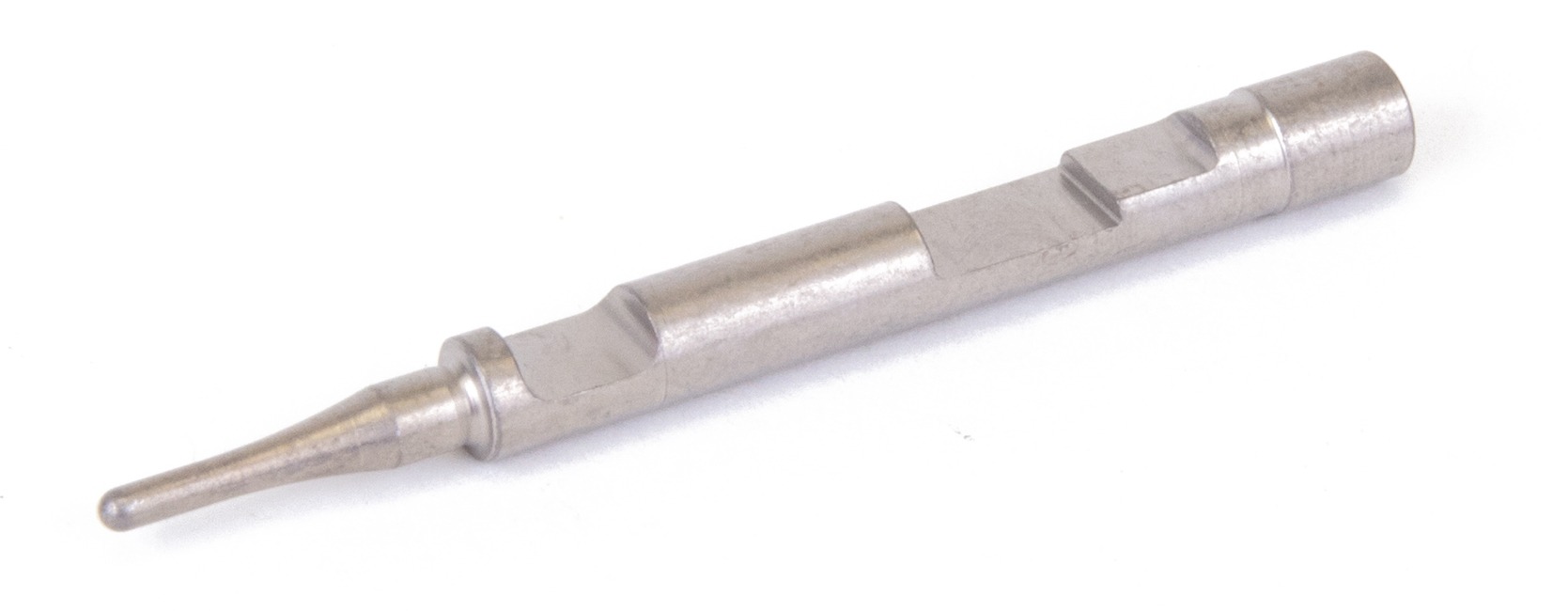
Gun pins are small mechanical components that secure, align, or retain parts within a firearm. Unlike decorative gun-themed lapel pins, these components have a functional role, helping individual parts remain correctly positioned while allowing movement where the design requires it. Depending on the firearm, pins may serve as pivot points, hold an assembly together, or support parts that move during normal operation. The broader term can also include firing pins, which have a separate role in the ignition system rather than simply holding components in place. Although many pins look uncomplicated, their dimensions and construction are closely tied to the assembly they serve. Solid pins, spring-style pins, and tapered designs achieve retention in different ways, so similar appearance does not establish compatibility. A pin that looks nearly identical to another may differ in diameter, working length, end profile, or retention features. Those differences can affect alignment, movement, and the security of adjoining components. Selecting replacement firearm pins therefore starts with the exact firearm model, configuration, and applicable parts documentation—not a visual match alone. Even firearms within the same family may use different hardware following a design revision or a change in assembly configuration. Manufacturer part references and model-specific diagrams are more useful than assumptions based on photographs. Where documentation identifies a particular assembly or revision, that information deserves the same attention as the firearm’s model name. A pin should not require improvised alterations to resemble the specified component, and a loose or unusually tight fit is not something to dismiss as a minor inconvenience. Correct fit protects the relationship between the pin and the surrounding parts. For an owner replacing worn hardware, the goal is to restore the intended mechanical relationship, not simply fill an opening with a piece of metal. When identification is uncertain, a qualified gunsmith can assess both the pin and the assembly it supports before the firearm returns to use.
Material, surface condition, and dimensional consistency all influence how firearm pins perform over time. Steel is common because it can provide the strength and wear resistance required for compact mechanical parts, while stainless steel and various protective finishes may offer additional resistance to corrosion in suitable applications. Material names alone, however, do not establish whether a component is correct for a particular firearm. Alloy selection, heat treatment, hardness, and geometry work together, and the specified combination matters more than a finish that looks especially rugged. A spring-style pin must retain the elastic properties its design requires; a solid pivot pin may depend on a consistent bearing surface and precise dimensions. Surface treatments can help protect hardware, but they do not eliminate the need for inspection or appropriate care. Wear may appear as polished contact areas, damaged edges, distortion, corrosion, or a change in how securely the pin remains seated. Some contact marks can reflect ordinary use, while others warrant professional evaluation, particularly when accompanied by unusual movement or a change in function. During routine maintenance, follow the firearm manufacturer’s guidance for cleaning products and lubrication, keeping in mind that excessive oil can attract residue rather than improve protection. Abrasive cleaning, aggressive polishing, or unapproved chemicals can alter a protective finish or affect a critical surface. Hardware that has been bent, heavily corroded, or otherwise damaged should not be treated as serviceable merely because it still fits into an opening. Equally important, a replacement pin cannot correct every problem around it. Wear in an adjoining component may also need attention. If a pin repeatedly moves out of position or the same area develops recurring wear, the underlying cause deserves inspection instead of repeated replacement alone. Any examination or maintenance should begin with the firearm unloaded, ammunition removed from the work area, and the applicable safety and service instructions close at hand.
These small components matter to a broad range of firearm owners, from recreational target shooters maintaining a familiar setup to collectors preserving the correct configuration of a valued firearm. Professional armorers and qualified gunsmiths also depend on accurately identified hardware when evaluating wear or returning an assembly to its intended condition. The practical considerations are often ordinary ones: a component removed during authorized maintenance needs replacement, an inspection reveals corrosion, or an older firearm requires confirmation that its existing hardware matches the documented configuration. In each case, careful identification is more useful than choosing a part because it resembles the original from across a workbench. For rifle-specific hardware, Rifle Pin Assemblies provides a related category to consider alongside the relevant model information and service documentation. Keeping replacement hardware organized also helps prevent confusion later. Clearly labeled packaging, the original part reference, and a record of the intended firearm or assembly can distinguish components that appear nearly identical when placed side by side. Separate storage is especially helpful in households or workshops with several firearms, where a small difference in pin length can be easy to overlook. A clean compartment or labeled container protects loose hardware from grit and makes its identity easier to verify without relying on memory. For gift giving, functional firearm parts call for more certainty than general accessories: the recipient’s exact equipment and an established need should be known before selecting model-dependent hardware. These are practical maintenance components rather than universal gifts. Their value comes from precise suitability, dependable materials, and the condition of the complete assembly in which they function. Whether the firearm is used regularly at the range or maintained as part of a collection, sound selection and appropriate care help preserve its intended operation. The smallest visible part can still deserve the same attention to documentation, inspection, and fit as a much larger component.