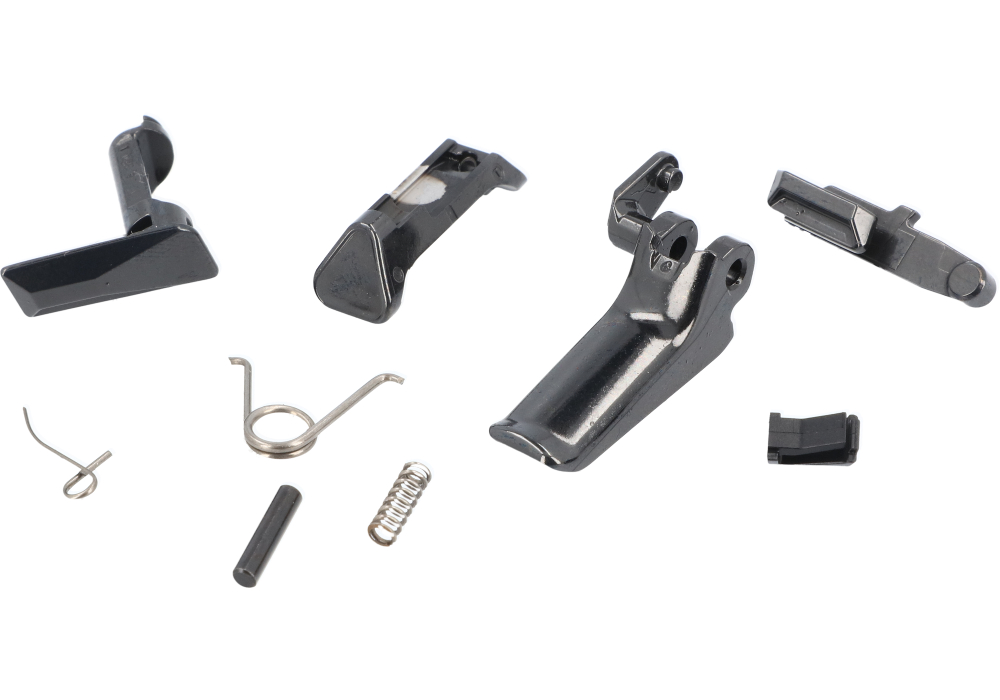
Control levers are mechanical handles or pivoting components that allow a user to operate, select, or release a function within a larger mechanism. In firearms, the term can describe several types of controls, including safety selectors, slide catch levers, bolt catch levers, and decocking levers, depending on the platform. These parts may look similar at a glance, but their functions, engagement surfaces, and compatibility requirements can differ substantially. A safety lever controls a mechanical safety function, while a decocking lever serves a different purpose on firearms designed with that feature. A catch lever interacts with the slide or bolt according to the firearm’s operating system. The correct choice therefore depends on more than appearance or the general name of the part. The firearm’s exact model, configuration, and manufacturer documentation establish which control belongs in a particular application. For owners replacing a worn component or maintaining a familiar setup, matching those requirements helps preserve the intended relationship between the external lever and the internal mechanism. Shape also matters at the point of contact: a broad paddle, a narrow tab, or a gently contoured surface can feel quite different beneath the thumb, even when each serves the same general category of function. Surface texture may provide a distinct contact point, while the lever’s profile determines how far it extends from the surrounding frame or receiver. Those details deserve attention alongside mechanical compatibility, especially when an existing holster, case, or other accessory fits closely around the firearm. For controls specifically associated with a firearm’s mechanical safety, Safety Levers offers a more focused category. Across all control lever types, a clear understanding of the intended function is more useful than choosing by silhouette alone. Similar names do not establish interchangeability, and a lever that physically fits into an opening is not necessarily compatible with the mechanism behind it. Even small differences in a pivot location, contact surface, or retaining arrangement can distinguish one application from another.
Materials and construction influence how a control lever withstands repeated contact, friction, and routine handling. Depending on the design, these components may use steel, aluminum alloys, or engineered polymers, with material selection reflecting the loads and interfaces involved. Steel can support durable engagement surfaces, while aluminum can reduce weight in applications designed around its properties. Polymer components likewise depend on the correct formulation, geometry, and intended role. No single material is automatically the best choice for every control. Heat treatment, dimensional consistency, surface finish, and the design of the complete assembly can matter as much as the material name. A protective finish may help resist corrosion and surface wear, but its suitability depends on the underlying material and the manufacturer’s specifications. Color and texture alone do not establish strength, fit, or service life. The underside of a lever, its pivot area, and its contact with adjacent components are often less visible than its outer face, yet those interfaces are central to correct operation. Compatibility information should account for the precise firearm variant and any documented production differences, rather than relying on a shared model family name. Left-side, right-side, and ambidextrous arrangements also require careful distinction; a control positioned on both sides may involve additional components or a different assembly altogether. For someone with a shorter thumb reach, the location and contour of a lever may be particularly relevant, but reach should be considered within the limits of approved configurations. A larger external surface is not inherently more suitable, especially if it interferes with the normal grip or surrounding equipment. A close-fitting holster illustrates the practical issue: a change in lever profile can affect clearance even when the firearm’s overall dimensions appear unchanged. When fitment is uncertain, manufacturer support or a qualified gunsmith can help establish the appropriate replacement and whether professional installation is required. Altering a lever to force a fit can change critical relationships that are not apparent from an exterior inspection.
Care and long-term durability depend on the lever’s working environment, the firearm’s maintenance requirements, and the condition of the surrounding mechanism. Repeated thumb contact can polish a textured surface, while residue or debris around a pivot can affect movement. A finish that shows light cosmetic wear does not necessarily indicate a functional problem, just as an unmarked exterior does not prove that internal engagement surfaces remain within specification. Changes in movement, unexpected looseness, visible damage, or a control that no longer behaves as described in the owner’s manual warrant evaluation before further use. Maintenance should follow the firearm manufacturer’s instructions, including its requirements for an unloaded condition, approved cleaning materials, and lubrication. Excess oil is not a substitute for correct fit, and aggressive abrasives or unapproved solvents can harm finishes or nearby materials. Control levers also belong within the broader context of responsible firearm ownership: a mechanical safety does not replace safe handling, secure storage, or attention to the condition of the firearm. For a recreational range user, an appropriate replacement may support continuity with a familiar setup. For an owner maintaining a firearm over many years, documented compatibility and a durable finish may take priority over a different external shape. In either case, the useful comparison is between the part’s stated application and the actual firearm, not between appearance alone. Owners who keep maintenance records can benefit from retaining the component description, compatibility documentation, and any professional service information with those records. That history can clarify what was installed and why if the firearm later requires inspection. For someone considering a firearm component as a gift, exact compatibility deserves confirmation with the recipient rather than an assumption based on a photograph or broad model name. Control levers are small components with specific mechanical responsibilities, and a suitable selection brings together the correct function, documented fit, appropriate materials, and care consistent with the firearm’s original design.