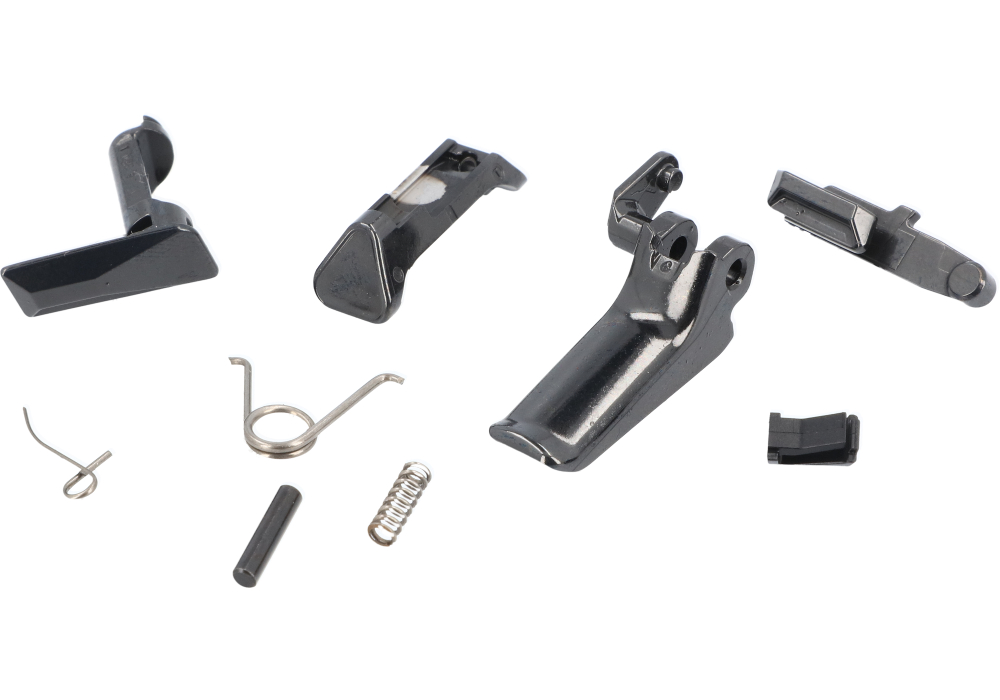
Firearm disassembly parts kits are sets of replacement components intended for maintenance or service of a compatible firearm. Depending on the kit, contents may include springs, pins, detents, retaining clips, or other small hardware associated with a particular assembly. Their purpose differs from that of a disassembly tool kit: replacement parts take the place of existing components, while tools help a qualified person perform the work. That distinction matters when comparing sets, because a collection of punches and bench accessories does not necessarily contain replacement hardware, and a parts kit does not necessarily include the equipment needed for installation. For equipment rather than replacement components, Firearm Disassembly Tools covers the related category. Choosing a parts kit begins with identifying the firearm accurately and checking the stated compatibility against its documentation. A shared model family, similar appearance, or matching general description is not enough to establish fit. Production revisions and differences between configurations can affect which components belong in an assembly, even when the exterior looks nearly identical. Kit descriptions should clarify the intended application and list the included pieces so that the contents can be compared with the actual maintenance need. A small hardware set may address a limited service task rather than provide every component associated with a complete firearm. Likewise, the word “kit” does not mean that every included part needs replacement at the same time. These sets are most useful when their contents correspond to a documented service requirement, a technician’s assessment, or an owner’s need for correctly identified spare hardware. They are not a shortcut to universal compatibility or a substitute for understanding the manufacturer’s maintenance limits. For someone facing a worn component or a missing piece during authorized maintenance, the important details are the component’s identity, its intended location, and the exact firearm configuration—not simply whether its outline resembles the original.
Materials and manufacturing quality matter because small components can perform demanding jobs despite their modest size. Springs rely on suitable material and consistent physical properties; pins and retaining hardware depend on dimensions and surface condition appropriate to their intended use. Steel is common in many of these applications, but material names alone cannot establish compatibility, service life, or suitability. Heat treatment, protective finishes, tolerances, and the design of the surrounding assembly also influence performance. A dark finish or polished surface may be visible in a photograph, while the dimensional differences that determine proper fit are not. Product specifications and manufacturer documentation therefore provide more useful information than appearance alone. Durable replacement hardware should meet the requirements of its original application, rather than promise a broad improvement across unrelated firearms. Normal use, maintenance history, and exposure to cleaning chemicals can all affect the condition of small parts. Visible corrosion, distortion, unusual wear, or an unexplained change in function warrants evaluation rather than guesswork about which replacement to install. A qualified gunsmith or armorer can distinguish between a component that needs attention and a problem elsewhere in the assembly. Care also extends to spare parts before they enter service. Original packaging, clear identification, and storage protected from moisture and grit help keep small pieces organized and their condition easier to assess. Tiny hardware can disappear beneath a bench or become difficult to distinguish when several similar pieces share an unmarked container. Keeping compatible sets separate reduces confusion, particularly in a workshop where more than one firearm platform receives maintenance. Cleaning products and lubricants should follow the firearm manufacturer’s recommendations; a treatment suitable for one material or finish may not suit another. Spare components should remain identifiable, and questionable pieces should receive professional assessment before use. A kit’s usefulness ultimately depends on correct fit, sound condition, and appropriate service—not the number of pieces in the package.
Owners who perform manufacturer-authorized maintenance, shooting enthusiasts who keep careful service records, and qualified armorers may all have a practical reason to consider firearm disassembly parts kits. For an individual owner, a compatible set can keep relevant replacement hardware together instead of leaving several nearly identical components scattered through a drawer. For a professional workbench, clearly labeled kits can support organized service records and make it easier to account for the parts associated with a particular job. The need may arise after regular range use, during an inspection, or when a technician identifies a component requiring replacement. In each case, the kit should match the task rather than encourage unnecessary work. Routine field maintenance and more involved disassembly are different levels of service, and owning replacement parts does not establish the training or equipment needed for either. Manufacturer instructions define the appropriate boundaries for owner maintenance, while work beyond those boundaries belongs with a qualified professional. Any handling or maintenance should involve a fully unloaded firearm, with ammunition kept separate from the work area. A tidy bench, adequate lighting, and careful identification of components support responsible maintenance without turning a collection of spare hardware into an invitation to experiment. Parts kits can also be a thoughtful gift for an experienced owner or a trained professional, provided the recipient’s firearm configuration and actual needs are known. Compatibility is too specific for a guess based on a familiar model name, and a general interest in shooting does not necessarily indicate an interest in mechanical service. For that reason, a parts kit is better suited to a recipient who has identified the correct set or can confirm its application. Clear contents, traceable identification, and a defined maintenance purpose give these products their value. The most appropriate kit is the one that supports the firearm’s documented requirements and the owner’s established maintenance practices, with professional assistance whenever fit or function is uncertain.