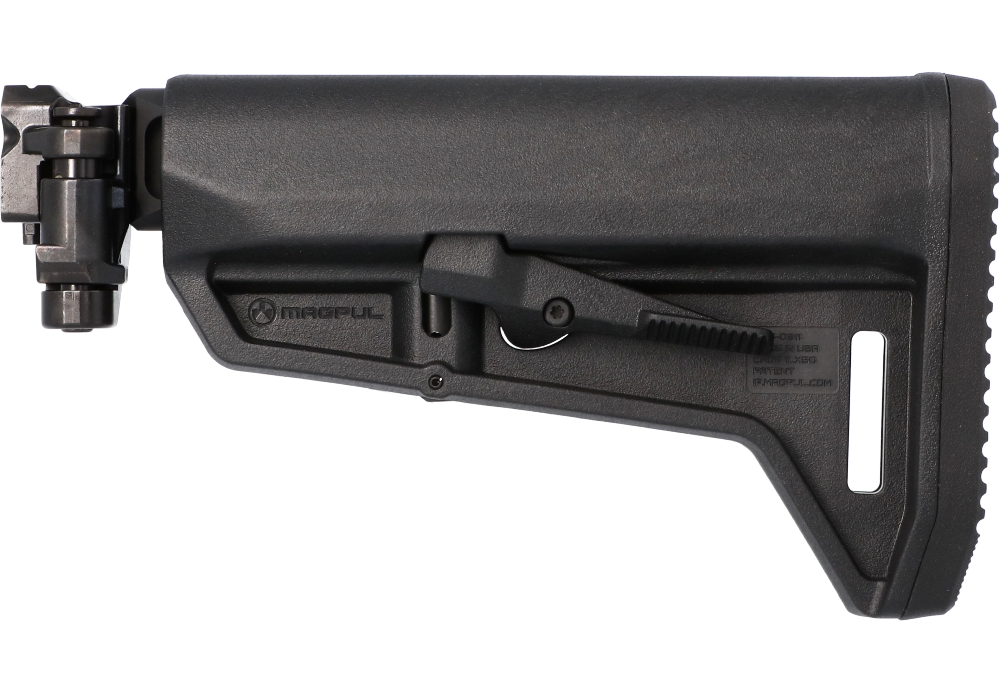
Folding adapters are firearm accessories that allow a compatible stock or brace to pivot alongside the receiver, reducing overall length for storage and transport. Their purpose is straightforward: a firearm that occupies less length can fit more comfortably into an appropriately sized protective case or secure storage space without requiring removal of the stock. In most arrangements, the adapter sits between the firearm’s rear mounting interface and the stock assembly, providing a hinged connection with a locking mechanism. That function is different from a telescoping stock, which adjusts length along the firearm’s centerline rather than folding to the side. Some setups combine both features, but neither function guarantees the other. For range shooters, hunters, and competitors, the practical benefit often appears before and after shooting: packing a case, organizing equipment, or fitting a rifle into a secure storage layout. The folded dimensions still depend on the entire firearm, including the barrel, receiver, stock, and attached accessories. A shorter folded profile does not necessarily mean a narrower one, since the stock may rest beside the receiver and increase the space required across the case. Compatibility is therefore the defining consideration for folding adapters. A rear rail interface, threaded receiver connection, and chassis-specific mounting point are different arrangements, even when the adapters look similar in photographs. The firearm’s operating system also matters. On designs that use a receiver extension as part of the recoil system, mechanical compatibility involves more than exterior dimensions or matching threads. A folded configuration must never be assumed suitable for firing; permitted operation depends on the firearm and adapter, as specified by their manufacturers. These accessories are best understood as platform-dependent components rather than universal hinges. A suitable match preserves the intended relationship among the receiver, stock, and operating system while providing the folding function described for that particular configuration. The most useful specifications identify the supported interface, stock connection, folding direction, and any operating restrictions clearly enough to evaluate the complete assembly.
Materials and construction influence how a folding adapter feels in use and how it holds up over time. Aluminum can offer a favorable balance of strength and weight, while steel may be used throughout an adapter or in concentrated wear areas such as pins and locking surfaces. Material alone does not establish quality: alloy selection, geometry, machining, surface treatment, and the design of the locking mechanism all contribute to durability. A hinge experiences repeated movement, but the extended assembly also needs a secure connection appropriate to its intended use. Excess movement at the joint can affect the feel of the stock against the shoulder, making the condition and engagement of the locking surfaces important considerations. Finishes help protect exposed surfaces, although coatings still experience wear where components contact one another or rub against a case. Smooth edges and consistent fit are useful details, particularly around the latch and hinge where hands naturally settle during handling. The adapter’s dimensions deserve equal attention. Added length behind the receiver can change the distance between the trigger and the rear of the stock, potentially affecting shoulder position and access to controls. Added weight also changes the balance of the complete firearm, even when the adapter itself appears compact. Folding direction affects where the stock rests and whether it overlaps a charging handle, sling attachment, or another control. The space occupied by the folded stock can also influence how the firearm sits against the padding in a fitted case. Some designs retain the stock in the folded position, while others use a different arrangement, so that feature should be confirmed rather than inferred from appearance. When the stock is also part of the selection, Folding Aluminum Stocks offer a related category to consider, with compatibility assessed across the full assembly. Some stocks incorporate their own hinge, while others require a separate adapter; those configurations are not automatically interchangeable.
Long-term ownership brings attention back to fit, care, and the way the firearm is handled between outings. Folding adapters have moving joints and contact surfaces, so their maintenance requirements differ from those of a fixed mounting block. Manufacturer guidance should determine cleaning methods, lubrication points, inspection intervals, and any service requirements. Excess lubricant can attract grit, while unsuitable cleaners may affect certain finishes or neighboring components. A clean exterior is helpful, but appearance alone does not establish that the hinge and lock are functioning correctly. Changes in engagement, unusual resistance, visible damage, or increased movement warrant evaluation by a qualified professional before further use. Installation and any later adjustments should likewise follow the applicable documentation, with a qualified gunsmith or armorer involved when needed. For someone who regularly travels to a range, a compatible folding setup can simplify case selection, but padding still needs to support the firearm without placing concentrated pressure on the hinge, latch, or controls. For a hunter carrying equipment between home, a vehicle, and a secure destination, the same compact storage benefit depends on a case that accommodates the folded width as well as the shorter length. A precision-oriented shooter may place greater emphasis on the extended stock position, consistent shoulder contact, and how the assembly fits an existing chassis. Across these uses, folding convenience should complement the firearm’s handling rather than compromise it. A folding mechanism is not a firearm lock or a substitute for secure storage, and folding the stock does not establish that the firearm is unloaded. Safe handling, secure storage, and applicable transport requirements remain essential regardless of configuration. Local requirements may also affect permissible firearm configurations, so mechanical fit is only one part of evaluating suitability. A well-matched folding adapter serves a clear, limited purpose: it provides a compatible folding connection while retaining the stock position and handling characteristics needed when the firearm is configured for its intended use.