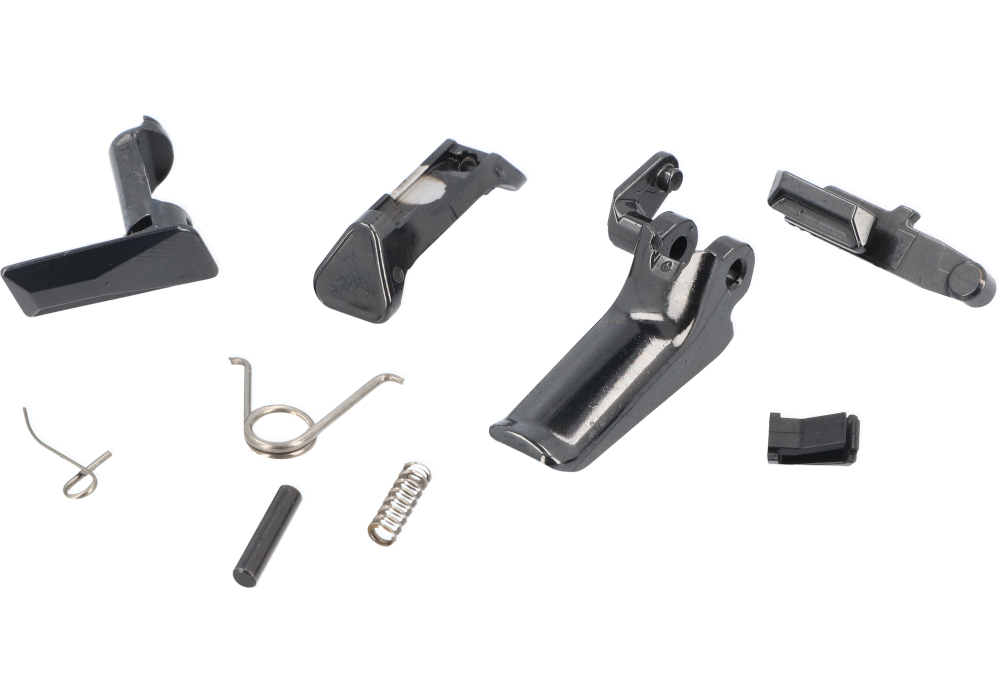
Gun detent springs are small compression springs that apply pressure to a detent pin, ball, or similar retaining component, helping a firearm control or pin remain in its intended position. The spring supplies force while the detent engages a corresponding notch, recess, or groove. Together, these parts contribute to the positive engagement felt when certain controls move between defined positions. Depending on the firearm’s design, detent springs may serve selector mechanisms, takedown pins, pivot pins, or other positioning assemblies. Their purpose is retention and consistent engagement, not the movement of ammunition through the firearm or the absorption of recoil. Although a detent spring can be small enough to disappear against a cluttered work surface, its dimensions and mechanical properties matter to the assembly it supports. A selector that engages with a distinct click and a retaining pin that stays seated both depend on the condition and fit of several interacting parts, not the spring alone. Gun detent springs belong to a specialized category of replacement firearm components, with applications determined by the host firearm and the exact mechanism involved. They are relevant to owners maintaining familiar equipment, armorers supporting multiple firearms, and gunsmiths addressing worn or missing small parts. For someone organizing a maintenance kit, clearly identified replacement springs can help keep similar-looking components separate and traceable to their intended applications. The useful distinction is not simply between a small spring and a large one; it is between a spring specified for a particular assembly and one that only appears close in size. That distinction becomes especially important when several springs share the same general coil shape. A spring intended for one retaining mechanism should not be assumed suitable for another, even when both components perform broadly similar jobs. Reliable selection begins with the firearm’s documented parts requirements and a clear understanding of which component the spring supports.
Fit is the central consideration when comparing firearm detent springs. Compatibility can depend on the firearm family, model, generation, configuration, and the particular location within the assembly. A broad platform description may be helpful, but it does not always resolve differences between variants or revisions. Relevant specifications can include free length, outside diameter, wire diameter, coil geometry, end configuration, and spring rate—the relationship between compression and the force the spring exerts. These characteristics work together within a defined space. Two springs with similar lengths may respond differently under compression, while a spring with a different diameter may not seat correctly in its intended recess. Greater resistance is not automatically an improvement, and a stronger spring is not a universal answer to a control that feels indistinct. Excessive force or an incorrect fit can interfere with the intended operation of the assembly. Materials also deserve attention, although the material name alone does not establish suitability. Spring steel, music wire, and stainless steel are among the materials used for small mechanical springs, with the specific alloy, processing, and surface treatment influencing their properties. Certain stainless alloys offer useful corrosion resistance, while other spring materials may rely on a protective finish and appropriate care. No material should be treated as immune to corrosion, fatigue, or damage. When material or finish information is provided, it is most useful alongside an explicit application and dimensional specifications rather than as a stand-alone promise of durability. Manufacturing consistency matters because a spring must operate within the space and compression range its assembly permits. Product descriptions that clearly identify the supported mechanism help distinguish selector detent springs from takedown or pivot pin detent springs and from unrelated retaining springs. Not every small coil spring in a firearm is a detent spring, and visual resemblance does not establish interchangeability. For a replacement intended to restore normal function, the manufacturer’s specified part and compatibility information provide a more dependable basis for selection than appearance or a general claim of increased strength.
Care and durability are closely connected to the condition of the entire detent assembly. Spring performance can be affected by corrosion, deformation, excessive compression, and repeated use, but an indistinct click or unusual resistance does not establish that the spring is the only source of a problem. Wear on the mating detent, damage to an engagement surface, or contamination in the mechanism may also affect how a control feels and functions. A sudden change in engagement warrants attention rather than an assumption that replacing one small component will resolve it. A firearm with questionable safety-control function should remain out of use until evaluated by a qualified professional. For routine ownership, care should follow the firearm manufacturer’s cleaning and lubrication guidance; extra lubricant is not a substitute for correct fit or sound components. Small replacement parts benefit from clean, labeled storage that protects them from moisture, debris, and crushing. Keeping each spring with its part identification is particularly useful at a workbench where several nearly identical coils might otherwise end up together. A well-organized parts container can preserve both the component and the information needed to use it appropriately. Owners maintaining firearms for range practice, competition, or other lawful activities generally benefit more from verified compatibility and consistent engagement than from choosing a spring solely for a different control feel. Professional service can help distinguish routine replacement needs from wear elsewhere in the assembly without relying on trial-and-error substitutions. Detent springs should also be distinguished from Trigger Springs, which serve different functions within the firing mechanism and have their own application requirements. Neither category should be treated as a collection of interchangeable coils. The practical value of a gun detent spring lies in how precisely it fulfills a modest but important role: maintaining pressure on the correct retaining component within the intended assembly. Clear specifications, suitable materials, careful storage, and attention to the surrounding mechanism help support that role throughout the service life of the part.