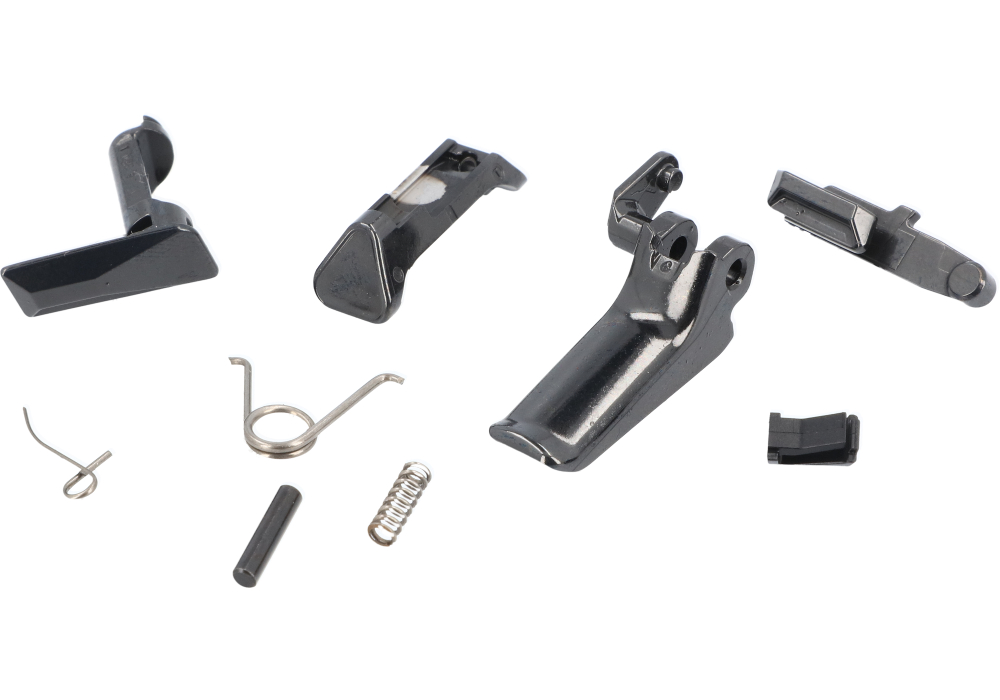
Pistol control parts are the mechanical interfaces used to operate a handgun, including triggers, magazine releases, slide stops, manual safety levers, and takedown levers, along with the internal components that support their function. Each serves a distinct purpose within the pistol’s design. The trigger interfaces with the firing mechanism, while the magazine release retains the magazine until the control is intentionally operated. A slide stop holds the slide open under the conditions specified by the firearm’s design; some designs also allow that control to release the slide. Where fitted, a manual safety restricts part of the firing mechanism, and a takedown lever supports the manufacturer’s prescribed maintenance process. Not every pistol uses the same arrangement, terminology, or combination of controls, so these components are best understood in relation to the firearm they fit. Their size, shape, placement, and surface texture influence how the handgun feels in the hand without changing the importance of safe handling. For someone with shorter fingers, the distance to a magazine release can be more noticeable than the size of its button. For someone with larger hands, the space surrounding a lever may matter more than its overall profile. A broad contact surface and a compact, closely fitted control offer different handling characteristics, and neither is automatically the better choice. Left-handed shooters may also need to distinguish between controls that are reversible and those that operate from both sides, since those descriptions do not mean the same thing. Texture deserves similar attention: grooves or checkering can provide a defined contact point, but their edges should remain comfortable against the hand during ordinary use. The value of pistol control parts lies in their relationship to the complete handgun, the shooter’s hand, and the intended setting. A familiar control layout, clear tactile feedback, and compatibility with the pistol’s original operating system provide a more useful basis for comparison than appearance alone.
Materials, dimensions, and finish help explain why seemingly similar handgun controls can differ in feel and service life. Steel is commonly used where strength and resistance to repeated contact are important. Aluminum can provide a lighter component where the design supports it, while suitable polymers can serve in controls engineered around their particular properties. Material names alone do not establish quality; geometry, manufacturing tolerances, surface treatment, and the demands placed on the component all contribute to durability. A visible lever may have a smooth outer face for comfortable contact while its less visible working surfaces require precise dimensions to interact correctly with neighboring parts. Protective finishes can help resist corrosion and surface wear, but no finish eliminates the need for inspection and appropriate care. Edges should be consistently finished, contact surfaces should match their intended role, and the component should meet the specifications for the handgun in question. Fit is especially important because a shared model family does not necessarily mean shared compatibility across every generation, frame size, or configuration. A part that resembles the original can still differ in its pivot location, retention features, or relationship to an internal mechanism. Matching the manufacturer’s stated application is therefore more meaningful than judging compatibility from a photograph. The distinction between a complete assembly and an individual component also matters, since the supporting pieces required for correct function depend on the design. External dimensions deserve attention beyond the pistol itself. A control with a different profile may interact differently with a holster, and the fit of that combination should not be assumed. Finish color and styling are secondary to these mechanical considerations, though a consistent finish can give replacement components a cohesive appearance. For routine replacement, maintaining the intended operating characteristics is a practical priority. Any change involving a trigger, safety, or related internal interface warrants professional assessment rather than an assumption that physical fit alone establishes correct function. Properly matched parts support the firearm as a system, not simply as a collection of separate pieces.
Pistol control parts serve a range of owners, from recreational shooters maintaining a familiar handgun to instructors, armorers, and professionals responsible for equipment used regularly. A pistol that accompanies its owner to frequent practice sessions may need attention to wear at contact points, while one used less often still benefits from periodic inspection and care consistent with its manual. Controls are touched repeatedly, and their exposed surfaces can collect perspiration, skin oils, dust, and residue. Cleaning methods and lubrication requirements vary by design and material, so the firearm manufacturer’s recommendations remain the appropriate reference. Aggressive cleaners, abrasive treatment, or excessive lubricant can create problems rather than solve them, particularly where small components interact with one another. Changes in movement, a damaged edge, looseness, or an unfamiliar feel can indicate a need for qualified evaluation; a control that still moves is not necessarily functioning as intended. Familiarity helps an owner recognize those differences, but inspection of safety-related components belongs with someone trained to assess the complete mechanism. For professional users, consistent handling characteristics and compatibility with established equipment requirements can be as important as the finish or shape of a single part. The broader category of Pistol Parts For Professionals provides related context for components serving those needs. Recreational users have similar reasons to prioritize fit and reliability, even when their schedules and equipment requirements differ. A magazine release should suit the pistol and the user’s reach; a slide control should retain its intended relationship to the slide; and a safety lever should function within the system for which it was designed. None of these considerations replaces secure storage, responsible handling, or training, and a mechanical safety is not a substitute for keeping the muzzle directed safely and the finger clear of the trigger until appropriate. Thoughtfully selected, correctly fitted control parts help preserve the familiar feel and intended function of a handgun. Material quality, precise compatibility, suitable care, and professional support where needed are the enduring considerations behind that choice.