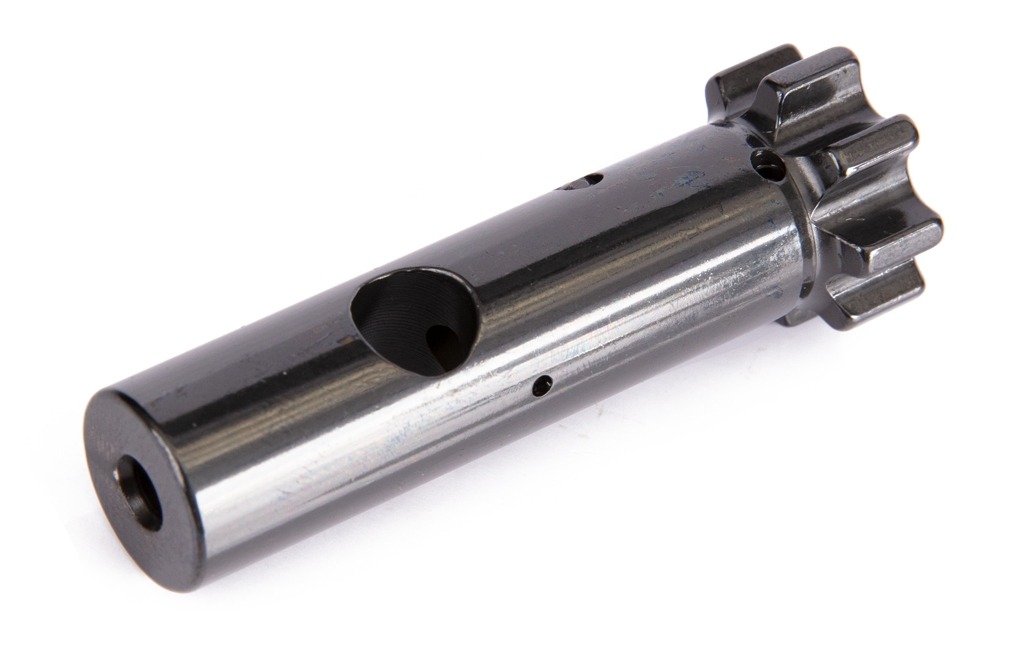
Bolt catch assemblies are mechanical control components that hold a firearm’s bolt or bolt carrier group to the rear and allow it to move forward when the control is released. On many AR-pattern rifles, the assembly works with the magazine follower to hold the action open after the final round, giving the shooter a visible indication that the magazine is empty. The exact operation depends on the firearm’s design, but the basic purpose remains consistent: controlling the action’s rearward retention rather than locking the breech for firing. A typical bolt catch assembly includes a catch lever, plunger, spring, and retaining pin or screw, although package contents and mounting arrangements vary. The catch provides the engagement surface and external paddle, while the spring and plunger provide the tension needed for its intended movement. The retaining hardware secures the assembly at its pivot point. Some replacement assemblies include these supporting components; others contain only the catch itself, so the distinction between a complete assembly and an individual replacement part matters. For an owner addressing a worn control, restoring an existing firearm, or maintaining equipment used regularly at the range, compatibility and dependable operation take priority over appearance. A clearly defined contact surface can also make the control easier to recognize by touch during supervised training. Holding the action open is useful during range procedures and chamber inspection, but an open action does not replace direct verification that the firearm is unloaded or adherence to safe handling practices. These assemblies are small compared with the receiver and operating group around them, yet their engagement surfaces and spring tension affect how consistently the hold-open function works. Understanding that role helps distinguish a bolt catch from nearby controls that may look similar but perform entirely different tasks. It also explains why a replacement deserves the same attention to fit and condition as more visually prominent components.
Fit begins with the firearm’s exact platform and receiver configuration, not simply the shape of the paddle. Receivers that appear closely related can use different catch dimensions, engagement geometry, clearances, or retention hardware. A familiar appearance or a broad compatibility description is not enough to establish suitability for every firearm in a family. Manufacturer documentation provides the appropriate reference for the intended model, and a qualified armorer can help resolve uncertainty about an existing assembly or replacement. Materials deserve similar attention. Steel is common for bolt catches because the engagement surfaces experience repeated contact with the moving action, while heat treatment and surface finishing contribute to wear resistance and protection against corrosion. Those characteristics work together; a dark coating alone does not establish the underlying material, hardness, or service life. Depending on the design, exterior surfaces may have a protective treatment that reduces exposed-metal wear, but no finish eliminates the need for inspection and appropriate care. The paddle’s profile also influences the ownership experience. A compact contact surface can preserve clearance around neighboring controls, while a broader or more pronounced surface may be easier for some shooters to locate. Texture can improve tactile recognition, although aggressive edges or excessive projection may be less comfortable for a particular hand position or equipment arrangement. Left- and right-handed users can have different preferences, but a larger catch does not automatically provide ambidextrous operation. That capability depends on the receiver and control system as a whole. For recreational range use, structured training, or organized competition, a suitable assembly should complement familiar handling without interfering with adjacent parts. Consistency matters more than an impressive silhouette: the catch needs appropriate clearance, secure retention, and engagement that matches the firearm’s specifications. An assembly selected for the wrong receiver cannot be corrected merely by choosing a different paddle texture or finish, which is why dimensional compatibility belongs ahead of cosmetic preferences.
Care for bolt catch assemblies centers on cleanliness, condition, and the firearm manufacturer’s maintenance requirements. Residue, grit, and excess lubricant can collect around small controls, making the pivot area and surrounding receiver surfaces worth attention during routine maintenance. Cleaning products and lubricants should be compatible with the firearm’s materials and finishes, with application governed by the manufacturer’s directions rather than the assumption that more lubricant always improves movement. Visible cracking, deformation, damaged retention hardware, unusual looseness, or a change in the hold-open function warrants evaluation by a qualified armorer. Surface polishing from normal contact can look different from a chipped or rounded engagement edge, and appearance alone may not establish whether a component remains serviceable. A catch that behaves inconsistently can also reflect an issue elsewhere in the firearm, including the magazine or operating system, so replacing the most visible part is not always a complete diagnosis. For owners who keep maintenance records, noting changes in control feel or function can provide useful context during professional inspection. Durability is best understood as the combined result of suitable materials, correct compatibility, proper installation, and ongoing care, not as a promise that any small mechanical component will last indefinitely. Related components such as Bolt Head Assemblies serve a different purpose within the action: the bolt head supports the cartridge base and, in rotating-bolt designs, carries locking features, while the bolt catch controls rearward retention. Keeping those roles distinct helps owners identify the correct component category when arranging maintenance or reviewing replacement needs. Whether the firearm sees occasional recreational use or frequent sessions under an instructor’s supervision, a suitable bolt catch assembly supports familiar, repeatable handling. The most useful choice is one that matches the receiver, preserves the intended function, and remains straightforward to inspect and maintain throughout regular ownership.