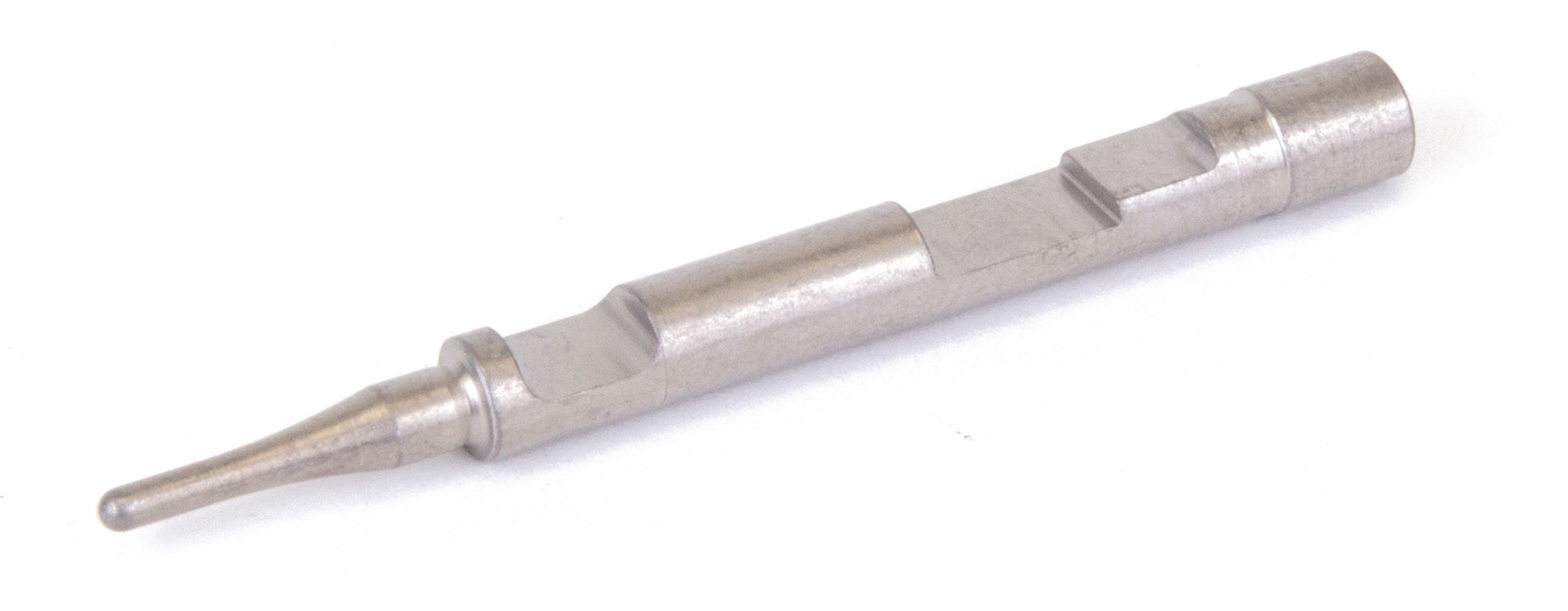
Firearm pin gunsmithing parts provide the small but essential hardware that keeps many assemblies aligned, retained, and operating as intended. A pin may look simple on a parts diagram, yet its diameter, length, profile, material, and finish can all affect fit and function. Common categories include roll pins, solid pins, taper pins, retaining pins, and firing pins, with each type designed for a different role. Roll pins are hollow, spring-steel cylinders that compress slightly as they are installed, making them useful for securing components such as controls, guards, levers, and other retained assemblies. Solid and taper pins provide firm alignment where close tolerances matter, while firing pins are precision internal components that transfer the impact of the operating system to the primer. When selecting a replacement, begin with the exact firearm make, model, generation, and configuration, then compare the part against the manufacturer’s specifications or an established parts diagram. Even a small difference in diameter or overall length can prevent proper installation or create unwanted movement. It is also important to distinguish between a complete replacement pin and a blank or unfinished part that may require fitting by a qualified gunsmith. For internal ignition components and any part related to safe firing, professional inspection is the prudent choice. Replacement hardware should be clean, undamaged, and free of burrs, with a finish suited to the surrounding components. Keeping a few correctly sized spares on hand can be useful for routine maintenance, especially when a small retaining pin is lost during disassembly or shows signs of deformation after repeated service.
The right installation tools are just as important as the pins themselves. Standard pin punches have flat tips intended for solid pins, while roll pin punches use a small rounded projection that centers inside a hollow pin and helps reduce the chance of flaring, splitting, or slipping. Starter punches are shorter and more robust, giving the user better control when beginning to move a tight pin before switching to a full-length punch. A gunsmithing hammer with brass, nylon, or polymer faces can deliver controlled force while helping protect surrounding finishes from unnecessary marks. A bench block or other properly supported work surface is valuable because it gives the assembly a stable place to rest and provides clearance for the pin as it exits. Good lighting, magnification, and a way to organize small hardware can make a noticeable difference; many frustrating repairs come from a misplaced pin, an unsupported part, or a punch that is slightly undersized. Before any work begins, unload the firearm completely, remove all ammunition from the work area, and follow the manufacturer’s disassembly and safety instructions. Never force a pin simply because it does not move at first. Some pins are directional, some are retained by other components, and some require a particular sequence for removal. Using the wrong punch can damage the pin, enlarge the hole, or leave marks on the frame or receiver. If resistance seems excessive, the part is unfamiliar, or the work involves the firing mechanism, seeking help from a trained gunsmith is a sound investment. For customers reviewing related replacement hardware, Firearm Parts Ejector Pins can also be considered when inspecting the small retention components within an ejection system.
Firearm pin gunsmithing parts may appeal to experienced owners, competitive shooters, collectors, armorers, and hobbyists who prefer to keep carefully selected maintenance supplies available for their own equipment. They can also make a practical gift for someone who enjoys organized bench work, attends training sessions, maintains a collection, or spends cooler months restoring and servicing sporting arms. A useful gift is not necessarily the largest assortment; a well-matched set with clearly identified sizes, durable storage, and the appropriate punch profiles is often more valuable than a box of unfamiliar pieces. Purchase decisions should account for whether the intended use involves roll pins, solid pins, taper pins, or a combination, as well as whether the tools are sized for compact components or larger assemblies. Look for hardened, properly finished punch shafts, comfortable handles, replaceable hammer faces where applicable, and cases that keep each size separated and easy to identify. For replacement pins, confirm dimensions rather than relying only on a general description, and check whether the part is factory-specification, oversized for a particular repair, or intended to be fitted. It is wise to inspect existing pins during normal cleaning for mushroomed ends, bends, corrosion, looseness, or marks caused by improper removal. Any replacement should seat securely without excessive force and should not be substituted with improvised wire, nails, or hardware of unknown specification. During the cooler months, a clean, well-lit workbench can turn routine maintenance into a focused part of responsible firearm ownership, but careful preparation matters in every season. Store small parts in a dry location, keep them labeled by firearm and position, and verify function and safety checks according to the owner’s manual after professional or owner-permitted maintenance. With the correct pin, the correct punch, and a measured approach, these compact gunsmithing components support dependable service while helping protect the fit, finish, and integrity of the firearm.